Spaced repetition with FSRS
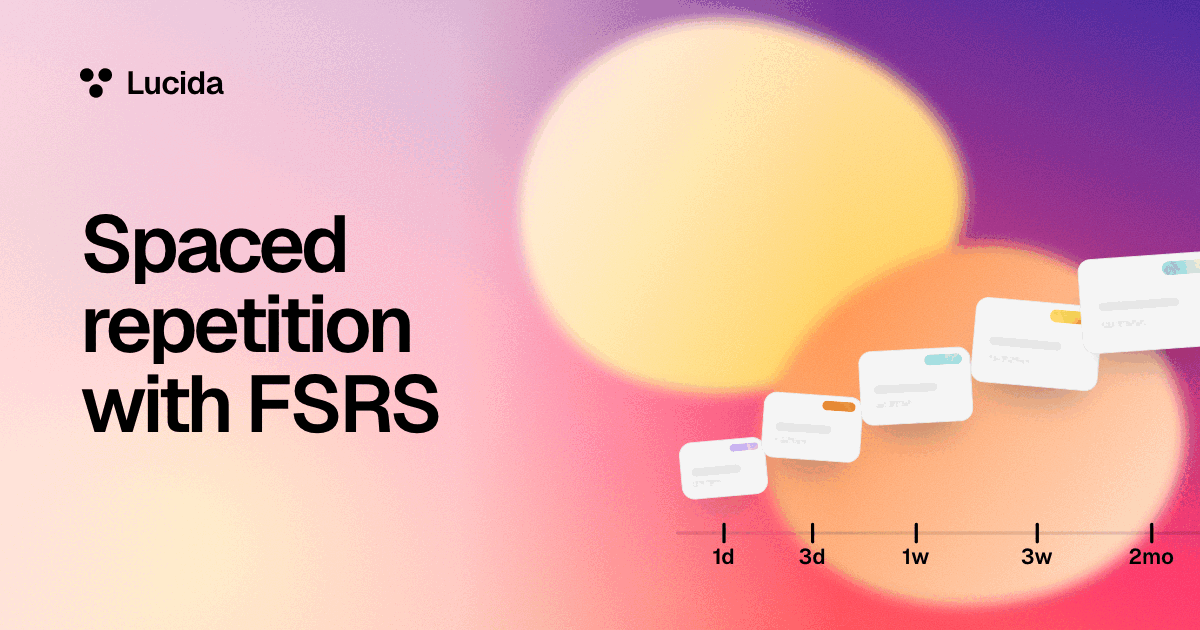
Lucida plans every review with FSRS, an open-source spaced repetition algorithm: after each answer it works out the day you’d still have about a 90% chance of remembering that card, and brings the card back then. It’s in the free plan, and you can change the goal, the longest gap and the new cards a day for each deck.
On this page
At a glance
| Feature | What Lucida does | Can you change it? |
|---|---|---|
| Algorithm | FSRS version 5 (19 parameters) | No. Four grades and the check or X always use it. To study without review dates, grade with piles |
| Grades | Forgot, Hard, Good or Easy, and each button shows the next gap | Per deck: four grades, a simple check or X (both use FSRS), or piles (piles only sort cards and give no review dates) |
| Remember goal | 90% | No |
| First reviews of a new card | After 1 minute, then after 10 minutes | No |
| Longest gap | 1 year | No |
| New cards a day | 20 | Any number up to 999 for each deck |
| Daily review limit | None: everything due is in today’s list | No |
| Cards you keep forgetting | Tagged Leech after 8 forgets | Pro: change the count, or pause them |
| Exam date | Pro: in the last 30 days, cards you’d forget by the exam come up early | Pro |
| Tuned to your own reviews | Pro, once you have 400 graded reviews | Pro: switch back to the standard settings any time |
Show all 10Show fewer
What spaced repetition is
Spaced repetition means seeing something again after a gap that gets longer each time you remember it. A card you forgot comes back soon. A card you knew comes back much later, so most of your time goes to the cards that need it.
It rests on two habits that research keeps finding help: testing yourself, and spreading your study out. In Kornell’s 2009 flashcard experiments, spacing beat cramming for 90% of the people tested, yet after their first session 72% of them believed cramming had worked better. A 2006 review of 317 experiments (Cepeda and colleagues) found that the longer you need to remember something, the longer the best gap between study sessions. A review of ten study techniques (Dunlosky and colleagues, 2013) rated practice testing and distributed practice as high utility.
What FSRS is
FSRS stands for Free Spaced Repetition Scheduler. For every card it tracks three numbers: how likely you are to remember the card right now, how many days it takes that chance to fall from 100% to 90% (its stability), and how hard the card is for you. Each answer updates them, and the next review is set for the day your chance of remembering falls to 90%.
FSRS is open source, and Anki has offered it since version 23.10. The FSRS project says it needs 20 to 30% fewer reviews than the older SM-2 scheduler for the same amount of remembering, and adds that this figure comes from simulations, not from measuring people.
Lucida uses FSRS version 5, which has 19 parameters. The newest version, FSRS-6, has 21, and Anki has offered it since version 25.07. Lucida doesn’t have it yet.
How a review works, step by step
- 1. See the front and try to answer. Say or write your answer before you flip. The retrieval practice guide from Agarwal and colleagues says that actually recalling and writing down an answer helps more than flipping the card early.
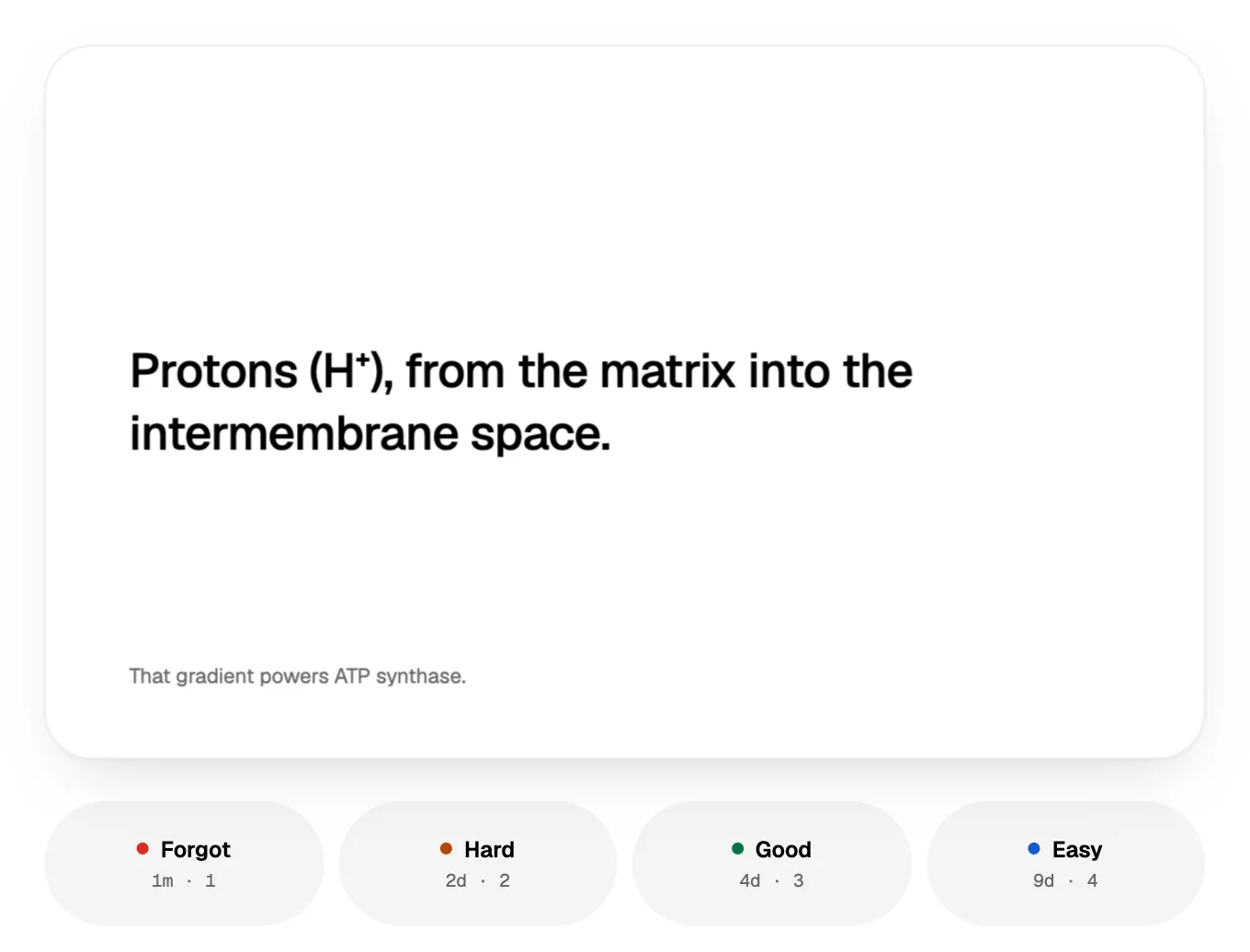
- 2. Flip and say how well you knew it. Choose Forgot, Hard, Good or Easy. Each button shows how long until you’d see the card again, like 10m, 6d, 12d or 28d.
- 3. New cards come back soon. A new card comes back after 1 minute, then after 10 minutes, and from then on it comes back after days. Press Easy on a new card and it skips the short waits. Short first waits fit Anki’s manual, which recommends learning steps under a day when you use FSRS, because repeating a card many times in one day adds little to long-term memory.
- 4. Your chance of remembering sets the gap. For a card you’ve learned, Lucida picks the whole number of days at which your chance of remembering falls to 90%, up to a year. A card you knew well gets a long gap. A card you found hard gets a shorter one.
- 5. Forgot means relearning. The card comes back after 10 minutes, then with a shorter gap than before. For a card you’ve learned, Hard, Good and Easy each give a gap at least a day longer than the button before.
- 6. Cards come due at the start of their day. Review, at the top of your Library, takes everything due: cards coming back within minutes first, then reviews, then the day’s new cards. Made a slip? Undo puts the last card back.
- 1st
- 1 min
- 2nd
- 10 min
- 3rd
- 6 days
- 4th
- 12 days
- 5th
Missed days and backlogs
You don’t have to study every day. FSRS works from the real time since you last saw each card, so a card you still remember after a long wait counts as strong, and one you forget after a short wait counts as weak. The Anki FAQ says FSRS also handles reviews that come late, such as after a break of weeks or months, much better than Anki’s older scheduler.
Lucida has no daily review limit, so a backlog shows up in full. If it grows, lower the new cards a day for a while, because each new card brings extra reviews later. Anki’s manual estimates that learning 20 new cards a day settles at roughly 200 reviews a day, and says that adding new cards while you’re behind can make a backlog worse.
Pick your remember goal
The remember goal is the chance you want of remembering a card when it comes back. A higher goal means shorter gaps and more reviews. Anki’s manual says 90% is a good balance, that the workload climbs quickly above 90%, and that above 97% it can be overwhelming. Lucida uses 90% for every deck, so there’s nothing to set.
Cards you keep forgetting
After you’ve forgotten a card 8 times, Lucida tags it Leech so you can find it. Anki calls these cards leeches too. Its manual says the most efficient fix is to change how the information is presented, since often the card holds too much or you don’t fully understand it yet.
On Pro you can change the count (from 3 to 30) and choose to pause leeches instead of only tagging them. Pro’s Stats page lists them, with a button to study just those cards.
Exam dates (Pro)
Add an exam date to a deck. From 30 days before, a card comes up early once your chance of remembering it slips under a target that rises from 90% to 95% on exam day. So the cards you’d probably forget by then get an extra look, and the whole deck is fresh for the test. Each of those reviews is a normal one, so after the exam your usual schedule carries on.
Stats shows, for each exam deck, the days left, how many cards you’ve seen and learned, and how much of the deck you’d likely remember on the day if you stopped studying now.
Tune to you (Pro)
FSRS starts from standard parameters from the FSRS project. After 400 graded reviews (at least 100 of them reviews of cards you’d already learned), Pro can fit FSRS’s 19 parameters to your own history, so the gaps match how fast you really forget. It runs in your browser, in the background. When you’ve added a quarter more reviews, it quietly tunes again, and you can switch back to the standard settings at any time.
Anki’s manual says the same kind of optimizer has little to learn from when there are fewer than a few hundred reviews.
What Lucida doesn’t do
- It doesn’t use FSRS-6 yet. Lucida runs FSRS-5.
- It doesn’t read your Anki review history. Cards you import start as new cards (see importing).
- Gaps are exact, with no random spread, so cards you learned together tend to come back together.
- It doesn’t work offline. Lucida needs an internet connection.
- The 20 to 30% figure above is the FSRS project’s own simulation result, not a measurement of Lucida’s users.
Test yourself
Show the answerShow the questionWhat does FSRS do after each answer?It works out the day you’d still have about a 90% chance of remembering that card, and brings it back then.
Show the answerShow the questionHow many new cards a day does Lucida start you at?20 a day. There’s no daily review limit, so everything due is in today’s list.
Show the answerShow the questionHow many graded reviews does Pro need to tune FSRS to you?400 graded reviews, at least 100 of them reviews of cards you’d already learned.
Show the answerShow the questionDoes Lucida use FSRS-6, the newest version?Not yet. Lucida uses FSRS version 5, which has 19 parameters, and the newest version has 21.
Questions
What is spaced repetition?
Spaced repetition is reviewing something again after a gap that grows each time you remember it, so you see it just before you’d forget it. Flashcard apps use it to plan which cards to show each day.
What is FSRS?
FSRS (Free Spaced Repetition Scheduler) is an open-source algorithm that estimates how likely you are to remember each card and schedules the next review for when that chance falls to 90%. Anki has offered it since version 23.10, and Lucida uses it to plan your reviews.
Is FSRS better than SM-2?
The FSRS project says it needs 20 to 30% fewer reviews than SM-2 for the same amount of remembering, based on simulations, and Anki’s FAQ says users do fewer reviews with it. Lucida doesn’t offer SM-2, so there’s nothing to switch.
What should I set my remember goal to?
Start with 90%, the default. Higher goals mean more reviews a day, and Anki’s manual warns that above 97% the workload can be overwhelming. Raise it only for something with a date and a real cost for forgetting, like an exam.
How many new cards a day should I learn?
Lucida starts you at 20 a day. Each new card adds reviews later, so if your due list keeps growing, lower the number. Anki’s manual estimates that 20 new cards a day settles at roughly 200 reviews a day.
What if I miss a day, a week or a month?
Open Lucida and start on the list. FSRS uses the real time since each review, so nothing resets. If a lot is overdue, pause new cards until you catch up.
Can I turn spaced repetition off?
Only by grading a deck with piles, which only sort cards and give no next review date. Four grades and the check or X always schedule with FSRS.
Is spaced repetition proven to work?
Decades of experiments support spacing and self-testing. A 2006 review covered 317 experiments, and a 2013 review of ten study techniques rated practice testing and distributed practice as high utility. Most of that research is on memory for words and facts, so it doesn’t say flashcards replace practice problems or essays.
How is Lucida different from Anki’s FSRS?
Both schedule with FSRS. Lucida runs version 5, and Anki has offered version 6 since 25.07. For a full side-by-side with sources, see Lucida vs Anki.
Keep reading


Sources (9)
The pages this one was written from, and the day each was checked.
- Kornell (2009), Optimising learning using flashcards: Spacing is more effective than cramming, Applied Cognitive Psychology · checked September 30, 2026
- Cepeda and others (2006), Distributed practice in verbal recall tasks: A review and quantitative synthesis, Psychological Bulletin · checked September 30, 2026
- Dunlosky and others (2013), Improving Students’ Learning With Effective Learning Techniques, Psychological Science in the Public Interest (Association for Psychological Science summary) · checked September 30, 2026
- Agarwal, Roediger, McDaniel and McDermott (2020), How to Use Retrieval Practice to Improve Learning, retrievalpractice.org · checked September 30, 2026
- Anki FAQ: What spaced repetition algorithm does Anki use? · checked September 30, 2026
- ABC of FSRS, open-spaced-repetition wiki · checked September 30, 2026
- Anki Manual: Deck options · checked September 30, 2026
- Expertium, A technical explanation of FSRS · checked September 30, 2026
- Anki Manual: Leeches · checked September 30, 2026